Had an idea? Pollis helps you test it, in code you own, and then improve and expand it.
A free, open-source desktop environment to explore data, build models, run simulations and solve optimisation problems: from your first click to your own code in Julia.
Installing on macOS
- Download Pollis for Mac (Pollis-darwin-arm64.zip).
- Unzip it (double-click it in Downloads).
- Move Pollis.app to Applications (drag it onto Applications in the Finder sidebar).
- Then in Terminal (press Command-Space, type Terminal, press Return) run
xattr -cr /Applications/Pollis.appand press Return (the app is not signed yet). - Open it by double-clicking Pollis.app in Applications.
Installing on Windows
- Download Pollis for Windows (Pollis-win32-x64.zip).
- Unzip it (right-click it in Downloads, Extract All..., Extract).
- Open the folder Pollis-win32-x64.
- Open it by double-clicking Pollis.exe. If SmartScreen warns, choose More info, then Run anyway.
Installing on Linux
- Download Pollis for Linux (Pollis-linux-x64.tar.gz).
- Extract it in a terminal with
tar -xzf Pollis-linux-x64.tar.gz. - Run
Pollis-linux-x64/pollis.
Pollis is young and growing quickly. Some features are still being built, and you may meet the odd rough edge. Your feedback at contact@pollis.org helps decide what comes next.
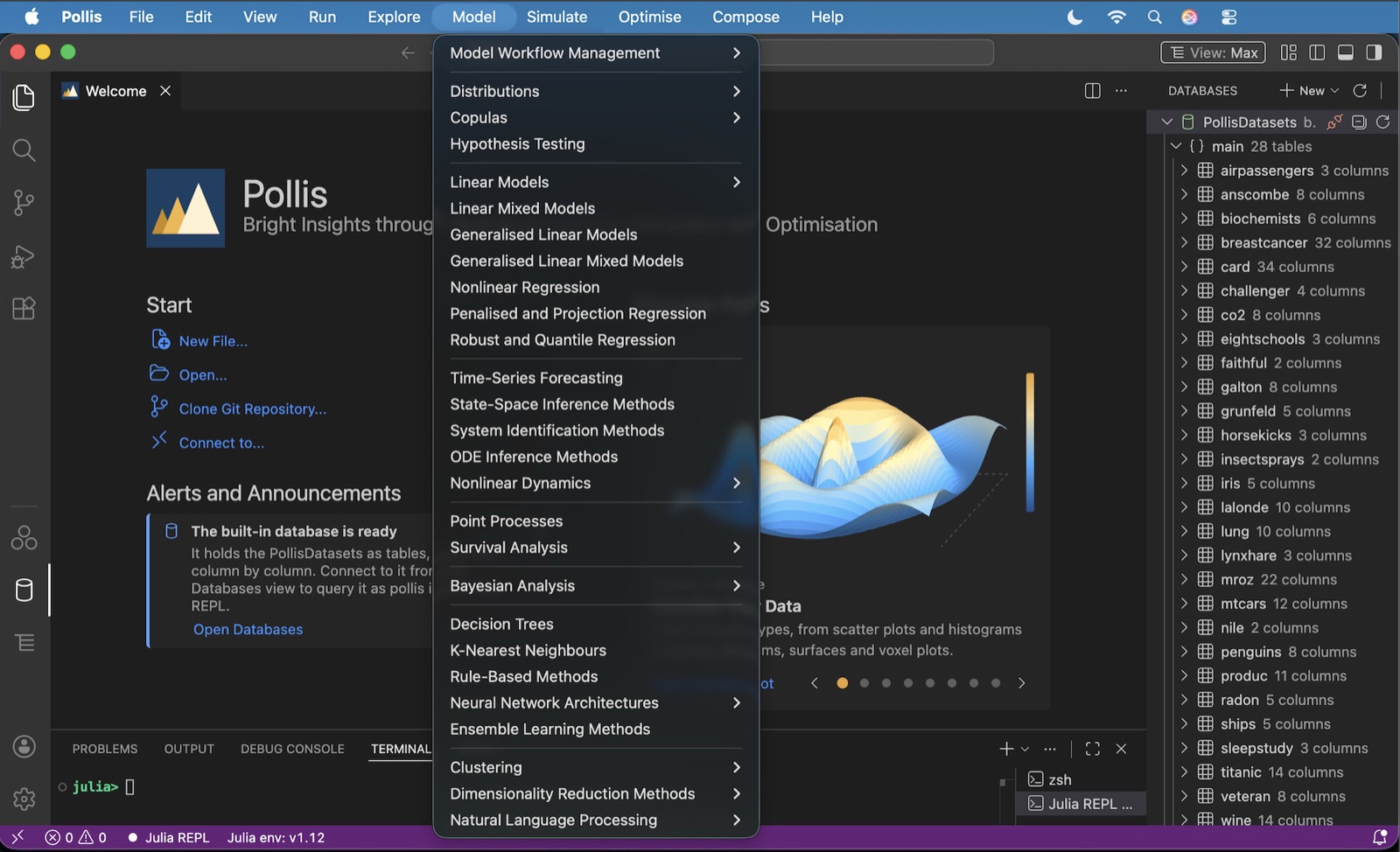
Data and a question? Start here.
Pick a method from a menu, fill in a few boxes, and Pollis gives you working Julia code that produces the result, with advice on what a careful analyst does next. You do not need to program to start.
Explore
What do my data look like?
Data from finance, economics and AI libraries, Excel, CSV or SQL. Thirty-five plot types, descriptive statistics, outliers and missing data.
Model
What explains it?
Regression with robust inference, generalised linear models, time series, survival analysis, Bayesian inference, machine learning and text analysis.
Simulate
What could happen?
Monte Carlo and Markov chain Monte Carlo, bootstrap, stochastic differential equations, agent-based and network models.
Optimise
What is the best decision?
Linear, convex and nonlinear programming, global and Bayesian optimisation, optimal control and reinforcement learning.
Why Julia
Julia is a modern, open-source language for scientific computing: as easy to read as Python or R, and as fast as C or Fortran. Its packages cover statistics, machine learning, differential equations and optimisation, and Pollis builds on them, so what you learn in Pollis carries over to Julia itself.
Free, open and yours
No licence fees, no lock-in, and code you can take anywhere.
Keep the code
Every panel writes readable Julia code that is yours, ready for the REPL, an editor or a notebook.
Learn good practice
Which method to choose, how to check it, and where to read more.
A familiar editor
Built on Code - OSS, so it looks and works like a code editor many people already know.
Open source
Licensed under the AGPL 3.0, on top of open-source Julia packages. Windows, macOS and Linux.
Learn more
The name
Pollis echoes the Greek polis, the community of citizens and the rules it freely adopts. Like a polis, Pollis is shared: free, open source, built on open-source packages, and open to change by those who use it. Its double l recalls the Greek pollá, “many things”: many fields and many methods in one place.